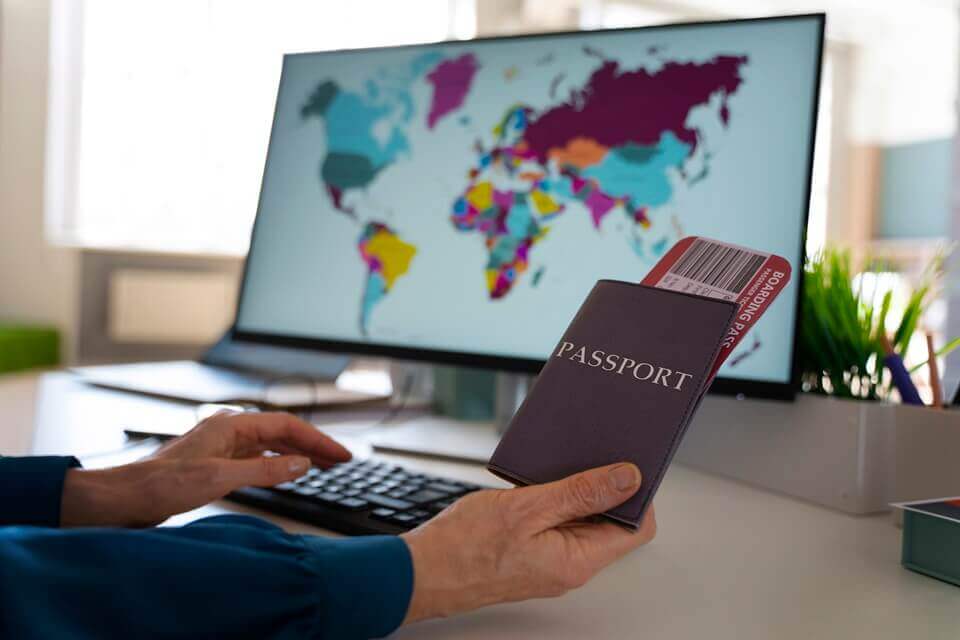
The answer to this question is unfortunately no, an approved Canada eTA cannot be used to visit anywhere in the United States. The United States has its own Electronic System for Travel Authorization (ESTA) program, which determines the eligibility of visitors to travel to that country under the Visa Waiver Program (VWP).
All travelers intending to go to the US under the VWP must obtain an ESTA authorization Before starting their trip. An approved ESTA is normally valid for two years and allows multiple visits to the U.S. during that time without the need to apply for another travel approval.
Travelers from the EU or any other country that requires an eTA to visit Canada must, therefore, also obtain an ESTA authorization to visit the United States.
If I am from the EU, can I apply for a US ESTA while I am visiting Canada?
Yes, you can apply for a US ESTA while visiting Canada. The Electronic System for Travel Authorization (ESTA) is an automated online system that determines the eligibility of visitors to travel to the United States under the Visa Waiver Program (VWP).
As a citizen of a VWP country, you can apply for an ESTA while in Canada, provided you meet the other requirements for the program.
As always, it is important to be aware that an approved ESTA does not automatically guarantee entry into the United States. The final decision is made by Customs and Border Protection officers at the port of entry.
What is the difference between a Canadian eTA and a work permit?
An Electronic Travel Authorization (eTA) and a work permit are two distinct documents with different purposes:
eTA (Electronic Travel Authorization)
The term eTA refers to an entry requirement for visa-exempt nationals of selected foreign countries who are transiting through or flying to Canada. It is electronically linked to the traveler’s passport and is valid for five years or until the passport expires, whichever comes first. It allows multiple entries to Canada by air. It does, however, not allow the holder to work in Canada.
Canadian work permit
A work permit, on the other hand, gives foreign nationals permission to work at a specific job, for a specific period of time, for a specific Canadian employer. It is issued by Immigration, Refugees and Citizenship Canada (IRCC) and is not related to entry into the country. It is required for individuals who want to work in Canada, regardless of whether they need an eTA or visa to enter that country.
To summarize, an eTA is aimed at entry into Canada by air for visa-exempt foreign nationals but does not allow work, while a work permit is specifically for those who want to work in Canada, irrespective of their entry status.
Can I work in Canada with a work permit but without an eTA?
No, that is also not possible. To take up employment in Canada you will need both a work permit and a valid visa or eTA.
A work permit gives foreign nationals permission to work at a specific job, for a certain period, and for a specific employer in Canada. It is issued by Immigration, Refugees and Citizenship Canada (IRCC) and is not related to entry into the country. To work in Canada, you must hold a valid work permit issued by IRCC in addition to an eTA or a visa. The good news is that your eTA or visa will be issued to you at the same time as your work permit, so you do not need to apply separately or pay an additional fee.
Can I study in Canada once I have an approved eTA?
No, an eTA also does give you the right to study in Canada. If you plan to study in that country, you will have to apply for a study permit in addition to the eTA. As in the case of a work permit, the study permit will also be issued at the same time as the eTA or visa, depending on your citizenship, so you will not have to apply separately or pay an additional fee for the eTA or visa.
What should I do if I end up in hospital while I am visiting Canada on an eTA and I can’t leave the country before the eTA expires?
If you are unable to leave Canada due to medical reasons, you should contact your country’s embassy or consulate in Canada for assistance. Additionally, if you have travel insurance, you should contact your insurance provider to see if they offer emergency travel assistance, which can help manage and pay for eligible medical expenses and coordinate emergency referrals to medical care and case management.
In case of a medical emergency, you can also apply for an extension of your stay online or by mail before your eTA expires. You will, however, have to meet certain eligibility criteria to be granted an extension, such as having a valid reason for staying longer (e.g. a medical emergency) and providing proof that you are not working or studying without the proper authorization. You should also be able to prove that you have enough funds to support yourself during your extended stay. If your application for an extension is approved, you will be issued a new visitor record with a new expiry date.
What is important here is to not just overstay your eTA and then afterwards claim that you were not well so you could not leave the country. Follow the correct procedures described above, or you could cause yourself a lot of unnecessary trouble.
What will happen to me if I overstay my Canada eTA by six months and then try to leave the country?
If you overstay your Canada eTA by 6 months and then attempt to leave the country, you may face serious consequences. Overstaying a visa or an eTA in Canada is a violation of immigration law and can lead to being deemed ‘inadmissible.’ This means you may be denied a visa or an Electronic Travel Authorization (eTA) in the future. You could also be removed from Canada.
It is. therefore, important to take action if you have overstayed your eTA, and it is advisable to speak to an immigration lawyer who can explain your options and recommend the best course of action.
Depending on the circumstances, you may be able to extend your visa, be allowed time to leave the country without penalty, or be permitted to apply for a visa. It is very important, however, to address the overstay situation to reduce or mitigate the risk of any adverse action being taken against you now and/or in the future.
Which documents do I need if I want to attend a full-time study course in Canada?
To attend a full-time study course in Canada, you will need to apply for a study permit in addition to meeting other requirements. This is a document that authorizes someone to stay and study in Canada. To apply for one, you will have to provide the following documents:
- Acceptance letter: A letter issued by the school confirming your acceptance into your program of study.
- Proof of financial support: Proof that you have money to support yourself and any family members coming with you. You have to provide evidence that you will be able to cover your tuition fees plus your living costs (accommodation, food, etc.) for the first year in Canada.
- Identity documents: Birth certificate, marriage certificate if you are married, and your passport.
- Educational documents: Marksheets and transcripts of your education records starting from Class 10th to your highest level of education.
- English proficiency test result: This is important to provide proof of your English proficiency.
- Educational credential assessment: This works as proof that your foreign degree/diploma/certificate is valid and equal to a similar Canadian qualification.
- Course-specific documents: Depending on the type of course you are applying for, you may need to provide additional documents such as a high school certificate/diploma, statement of purpose, letter of recommendation from professors, GMAT/GRE scorecard, updated resume, essay, and a professional letter of recommendation.
If you would like to study full time in Canada, you should also be aware that meeting the above requirements does not automatically guarantee that your application for a study permit will be approved. You will also have to meet other eligibility criteria, such as having a clean criminal record, being in good health, and convincing an immigration officer that you will leave Canada at the end of your authorized stay.
Which are Canada’s most esteemed higher education institutions?
The following Canadian universities are renowned for their academic excellence, research contributions, and international esteem:
University of Toronto
– Location: Toronto, Ontario
– Notable for: Hub for innovation, significant contributions in various fields, and 11 Nobel laureates among its faculty and alumni.
University of British Columbia
– Location: Vancouver, British Columbia
– Notable for: Groundbreaking research, distinguished alumni, and being consistently ranked among the top 40 universities in the world.
McGill University
– Location: Montreal, Quebec
– Notable for: Rich history, emphasis on research and student success, and the highest number of Rhodes Scholars among Canadian educational institutions.
University of Alberta
– Location: Edmonton, Alberta
– Notable for: Over 44,000 students from 156 countries, offering over 200 programs, and being ranked 111th globally.
McMaster University
– Location: Hamilton, Ontario
– Notable for: Prestigious medical school, international faculty, and being ranked 189th in the world university rankings.
Sources
- https://www.cbp.gov/travel/international-visitors/esta
- https://www.usa.gov/visa-waiver-esta
- https://help.cbp.gov/s/article/Article-1094?language=en_US
- https://www.ircc.canada.ca/english/helpcentre/answer.asp?qnum=1045&top=16
- https://www.canada.ca/en/immigration-refugees-citizenship/services/visit-canada/eta/facts.html
- https://www.ircc.canada.ca/english/helpcentre/answer.asp?qnum=202&top=17